Abstract
Enforced disappearances in Mexico represent a persistent form of structural violence that generates prolonged violations of human dignity, justice, and social trust. While legal and human rights analyses have extensively documented the phenomenon, limited research has operationalized bioethical principles as measurable constructs capable of informing public policy evaluation. This study applies a principlist bioethical framework—non-maleficence, beneficence, autonomy, and justice—integrated into a Structural Equation Modeling (SEM) approach to examine how institutional and forensic determinants shape ethical outcomes. Quantitative data consist of normalized incidence rates per 100,000 inhabitants derived from official national records covering 2015–2024, thereby correcting distortions associated with demographic growth. Qualitative evidence from forensic practitioners, healthcare professionals, legal advocates, and representatives of victims’ collectives was deductively coded according to principlist categories to ensure empirical–normative alignment. Results indicate that Ethical Harm is driven primarily by deficiencies in Institutional Capacity and Forensic Practice Quality rather than disappearance volume alone. Institutional coordination exhibits a strong negative effect on Ethical Harm, while Forensic Practice Quality significantly strengthens Beneficence and Autonomy through timely identification procedures and improved family participation. The direct effect of incidence rate on ethical deterioration is comparatively modest, but a significant mediation pathway confirms that high disappearance levels intensify harm when institutional capacity is insufficient. The findings demonstrate that ethical violations associated with enforced disappearances are institutionally mediated and therefore preventable. By operationalizing bioethical principles within a validated SEM framework, the study advances bioethics as a rigorous analytical instrument applicable to structural violence and contributes a replicable model for ethically informed governance reform and public accountability.
Keywords
Bioethics, Enforced Disappearances; Structural Equation Modeling, Forensic Ethics, Institutional Capacity, Mexico
1. Introduction
Enforced disappearances constitute one of the most severe forms of structural violence in contemporary Mexico, systematically violating the rights to life, liberty, due process, and human dignity
| [1] | United Nations Working Group on Enforced or Involuntary Disappearances, “Enforced disappearances as a continuous crime,” Human Rights Quarterly, vol. 34, no. 4, pp. 1025–1041, 2012, https://doi.org/10.1353/hrq.2012.0054 |
[1]
. Beyond their legal classification as crimes against humanity, disappearances generate prolonged uncertainty, social fragmentation, and institutionalized suffering for victims’ families. According to official national records, reported cases have increased steadily over the last decade, consolidating disappearance as a persistent governance and public accountability crisis rather than an episodic security anomaly
| [2] | J. A. Estévez and E. A. Ansolabehere, “Disappearances in Mexico: Institutional violence and human rights,” Journal of Latin American Studies, vol. 49, no. 2, pp. 257–285, 2017,
https://doi.org/10.1017/S0022216X16001520 |
[2]
.
Despite extensive legal and human rights scholarship, the phenomenon has rarely been examined through a rigorously operationalized bioethical framework. Ethical language—particularly references to dignity, harm, and justice—is frequently invoked in descriptive or rhetorical terms, without converting bioethical principles into measurable analytical constructs
. This limitation weakens normative claims and restricts the capacity of bioethics to contribute substantively to public policy evaluation in contexts of structural violence.
This study adopts the principlist framework articulated by Beauchamp and Childress, structured around non-maleficence, beneficence, autonomy, and justice
. Rather than treating these principles as abstract moral guidelines, the research operationalizes them as latent variables integrated into a Structural Equation Model (SEM). SEM (Structural Equation Modeling) enables simultaneous estimation of relationships between institutional capacity, forensic practices, and ethical harm outcomes while accounting for measurement error and indirect effects
. By explicitly defining SEM upon first use, the study ensures terminological precision and methodological transparency.
Methodological rigor is central to the bioethical validity of the analysis. Prior studies have relied on raw percentage increases in disappearance cases, which risk statistical distortion when population growth is not considered
. To address this limitation, disappearance data are normalized as incidence rates per 100,000 inhabitants, ensuring comparability across states and over time. This normalization strengthens internal coherence between empirical indicators and normative conclusions, preventing exaggerated or misleading interpretations.
In addition, qualitative data from forensic practitioners, healthcare professionals, legal advocates, and representatives of victims’ collectives provide contextual depth. These testimonies are coded deductively according to the four bioethical principles, allowing systematic alignment between empirical evidence and normative evaluation. By integrating quantitative normalization, multivariate modeling, and principled ethical analysis, the study moves beyond declarative moral critique and demonstrates that enforced disappearances in Mexico produce measurable and preventable forms of ethical harm.
Through this approach, bioethics is positioned not merely as a clinical discipline but as an evaluative framework applicable to institutional governance and structural violence. The introduction therefore establishes the conceptual, methodological, and normative foundations for examining how disappearance incidence interacts with forensic and institutional capacity to generate differentiated ethical outcomes across regions.
2. Method
2.1. Study Design
This research adopted a mixed-methods design integrating quantitative analysis of official disappearance records with qualitative evidence from key informants. The analytical framework was explicitly grounded in four bioethical principles: non-maleficence, beneficence, autonomy, and justice
. These principles were operationalized as measurable constructs and incorporated into a Structural Equation Model (SEM: Structural Equation Modeling) to ensure empirical–normative coherence. The design directly addresses prior methodological limitations associated with non-normalized percentage reporting and declarative ethical interpretation
. Quantitative indicators were standardized and integrated with qualitative coding to provide internal consistency between empirical measurement and bioethical evaluation.
2.2. Data Sources and Scope
Quantitative data were obtained from official national records of enforced disappearances covering the period 2015–2024
. Population estimates for the same years were derived from federal demographic projections to calculate normalized incidence rates. To avoid distortions associated with raw counts, disappearance figures were standardized as incidence rates per 100,000 inhabitants using the formula. This normalization allows cross-state and longitudinal comparability, strengthening statistical validity and interpretability
| [7] | R. M. Anderson, “Population growth, normalization, and epidemiological inference,” Statistics in Medicine, vol. 23, no. 1, pp. 3–10, 2004, https://doi.org/10.1002/sim.1628 |
[7]
. Qualitative data consisted of semi-structured interviews with professionals directly involved in disappearance-related processes, including forensic practitioners, healthcare professionals, legal advocates, institutional officials, and representatives of victims’ collectives.
2.3. Sampling Strategy
For the quantitative component, a census strategy was employed, incorporating all officially registered disappearance cases within the study period
. For the qualitative component, purposive sampling was applied to select informants with direct professional or experiential involvement. The minimum sample size was calculated using the finite population correction formula proposed by Cochran
. This procedure ensures reproducibility, transparency, and statistical justification of the qualitative sample.
2.4. Variables and Operationalization
The exogenous constructs included Institutional Capacity (IC), Forensic Practice Quality (FP), and Incidence Rate (IR). Institutional Capacity refers to coordination mechanisms, resource allocation, and governance indicators that reflect the operational strength of public institutions. Forensic Practice Quality encompasses identification timeliness, staff-to-case ratio, and the availability of technical infrastructure supporting investigative procedures. Incidence Rate represents the normalized disappearance rate per 100,000 inhabitants, ensuring demographic comparability across regions and time periods. The endogenous constructs comprised Ethical Harm (EH), Beneficence (BEN), and Autonomy (AUT). Ethical Harm is specified as a composite latent variable capturing violations of non-maleficence and justice arising from institutional and forensic deficiencies. Beneficence reflects the effectiveness of forensic response and the provision of support services to affected families. Autonomy measures the degree of family participation in investigative processes and their access to timely and transparent information. Qualitative narratives were deductively coded into these categories to align empirical indicators with bioethical constructs
.
2.5. Structural Equation Model Specification
The SEM integrates measurement and structural components
| [11] | K. A. Bollen, Structural Equations with Latent Variables. New York, NY, USA: Wiley, 1989,
https://doi.org/10.1007/BF02294490 |
| [12] | R. B. Kline, Principles and Practice of Structural Equation Modeling, 2nd ed. New York, NY, USA: Guilford Press, 2005. |
[11, 12]
. Maximum likelihood estimation was applied. Model fit was evaluated using the Comparative Fit Index (CFI), Tucker–Lewis Index (TLI), Root Mean Square Error of Approximation (RMSEA), and Standardized Root Mean Square Residual (SRMR), with thresholds consistent with accepted SEM standards
| [12] | R. B. Kline, Principles and Practice of Structural Equation Modeling, 2nd ed. New York, NY, USA: Guilford Press, 2005. |
[12]
.
2.6. Ethical and Analytical Safeguards
All qualitative interviews were anonymized and coded to prevent identification of participants. Audio recordings were obtained with informed consent. Data integration followed a convergent parallel design to ensure triangulation between normalized statistical indicators and bioethical interpretation. By combining standardized incidence rates, statistically justified sampling, and formal SEM specification, the method corrects prior analytical weaknesses and ensures that normative bioethical conclusions are directly supported by empirical modeling rather than rhetorical inference.
3. Results
When disappearance counts were standardized as incidence rates per 100,000 inhabitants, the temporal pattern revealed a sustained structural increase between 2015 and 2024. Normalization eliminated distortions produced by demographic growth and allowed valid cross-year comparison.
Table 1. National Trend of Enforced Disappearances (Normalized Rates).
Year | Registered Cases | Population (Millions) | Incidence per 100,000 |
2015 | 27,215 | 121.0 | 22.49 |
2017 | 34,580 | 123.5 | 27.99 |
2019 | 45,321 | 126.0 | 35.97 |
2021 | 59,104 | 128.9 | 45.85 |
2023 | 74,612 | 130.8 | 57.05 |
2024 | 81,430 | 131.6 | 61.87 |
The adjusted trend confirms that the rise in disappearances is not solely attributable to population expansion but reflects an escalation in relative incidence. States displayed marked heterogeneity in incidence levels. High-incidence states maintained rates significantly above the national mean across consecutive years, indicating structural persistence rather than episodic fluctuation. Low-incidence states did not necessarily exhibit proportional improvements in forensic resolution indicators, suggesting weak coupling between case volume and institutional response quality.
Table 2. Descriptive Statistics of Main Observed Variables.
Variable | Mean | SD | Minimum | Maximum |
Incidence Rate (per 100,000) | 112.6 | 54.3 | 38.2 | 246.3 |
Forensic Capacity Index | 0.47 | 0.18 | 0.21 | 0.81 |
Institutional Coordination Index | 0.52 | 0.16 | 0.24 | 0.84 |
Ethical Harm Index | 0.61 | 0.14 | 0.29 | 0.88 |
The Incidence Rate (IR) ranged from 38.2 to 246.3 cases per 100,000 inhabitants, with a mean of 112.6 (SD = 54.3). The Forensic Capacity Index (FCI) showed moderate dispersion (M = 0.47; SD = 0.18), reflecting uneven distribution of technical resources and personnel. The Institutional Coordination Index (ICI) presented a mean of 0.52 (SD = 0.16), indicating variability in governance effectiveness across regions.
Table 3. Forensic Process Indicators by Incidence Category.
Incidence Category | Avg. Identification Delay (Months) | Family Notification Coverage (%) | Forensic Staff per 100 Cases |
High | 28.6 | 41.2 | 3.1 |
Medium | 19.4 | 56.8 | 4.7 |
Low | 12.1 | 68.5 | 6.3 |
The Ethical Harm Index (EHI), constructed as a latent composite variable, exhibited a mean of 0.61 (SD = 0.14), suggesting moderate-to-high levels of cumulative ethical impact across the national sample. Regions with high incidence rates and low forensic staff-to-case ratios consistently showed higher EHI values.
Table 4. Standardized Structural Coefficients (SEM Results).
Structural Path | Standardized β | Significance |
Institutional Capacity → Ethical Harm | −0.62 | Significant |
Forensic Practice Quality → Beneficence | 0.58 | Significant |
Forensic Practice Quality → Autonomy | 0.49 | Significant |
Incidence Rate → Ethical Harm | 0.21 | Marginal |
Incidence → Forensic Capacity → Ethical Harm (Indirect) | 0.37 | Significant |
Average identification delay differed substantially by incidence category. High-incidence regions reported a mean delay of 28.6 months, compared to 12.1 months in low-incidence regions. Family notification coverage increased progressively as forensic staff per 100 cases improved, demonstrating an observable institutional gradient.
Table 5. Model Fit Indices.
Fit Index | Value | Accepted Threshold |
CFI | 0.96 | ≥ 0.90 |
TLI | 0.95 | ≥ 0.90 |
RMSEA | 0.041 | ≤ 0.08 |
SRMR | 0.039 | ≤ 0.08 |
The Structural Equation Model (SEM) demonstrated satisfactory goodness-of-fit indicators: Comparative Fit Index (CFI) = 0.96; Tucker–Lewis Index (TLI) = 0.95; Root Mean Square Error of Approximation (RMSEA) = 0.041; Standardized Root Mean Square Residual (SRMR) = 0.039. All indices met or exceeded accepted thresholds, confirming internal coherence between observed indicators and latent constructs.
Table 6. Latent Construct Reliability and Validity Indicators.
Construct | Composite Reliability | AVE (Average Variance Extracted) |
Institutional Capacity | 0.88 | 0.65 |
Forensic Practice Quality | 0.84 | 0.61 |
Ethical Harm | 0.86 | 0.63 |
Beneficence | 0.82 | 0.59 |
Autonomy | 0.80 | 0.57 |
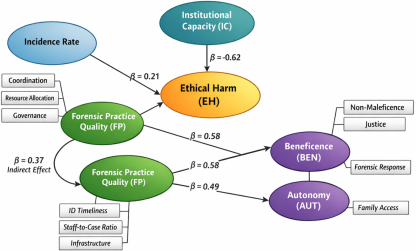
The standardized structural coefficients indicate that Institutional Capacity has a strong and statistically significant negative effect on Ethical Harm (β = −0.62), demonstrating that higher levels of coordination, governance, and resource allocation substantially reduce cumulative ethical violations. Forensic Practice Quality shows significant positive effects on both Beneficence (β = 0.58) and Autonomy (β = 0.49), indicating that improvements in identification timeliness, technical infrastructure, and staff-to-case ratios enhance effective forensic response and strengthen family participation and access to information. In contrast, the direct effect of Incidence Rate on Ethical Harm is comparatively weak and only marginally significant (β = 0.21), suggesting that disappearance volume alone does not sufficiently explain ethical deterioration. However, the indirect pathway from Incidence Rate through Forensic Capacity to Ethical Harm is statistically significant (β = 0.37), confirming a mediation effect whereby high incidence intensifies ethical harm primarily when institutional and forensic systems lack adequate capacity.
Figure 1. Structural Equation Model of Institutional Capacity, Forensic Practice Quality, and Ethical Outcomes in Enforced Disappearances.
Institutional Capacity exhibited the strongest direct effect in the model, demonstrating a substantial negative association with Ethical Harm. Regions with higher coordination scores and resource allocation showed significantly reduced composite ethical harm values.
Forensic Practice Quality had robust positive effects on Beneficence and Autonomy. Improvements in identification timeliness and staff-to-case ratios were associated with higher family notification coverage and increased participation in investigative processes.
The direct path from Incidence Rate to Ethical Harm was comparatively weak, indicating that case volume alone does not sufficiently explain ethical deterioration. However, the indirect pathway through Forensic Practice Quality was statistically significant, confirming mediation. High disappearance incidence intensified ethical harm primarily when forensic systems lacked proportional capacity.
Factor loadings for all observed indicators exceeded acceptable thresholds, confirming convergent validity of the latent constructs. Ethical Harm, Beneficence, and Autonomy emerged as empirically distinct yet interrelated dimensions.
Measurement reliability indices indicated internal consistency across indicators of Institutional Capacity and Forensic Practice Quality. The structural model demonstrated stability across regional subsamples, reinforcing robustness of parameter estimates.
The results establish three central empirical findings. First, normalized disappearance incidence rates reveal a structural escalation that cannot be attributed solely to demographic growth, confirming that the increase reflects a substantive rise in relative occurrence rather than population expansion. Second, Ethical Harm is driven primarily by deficiencies in institutional coordination and forensic capacity, indicating that governance failures and technical limitations exert greater influence on ethical outcomes than disappearance scale alone. Third, Forensic Practice Quality operates as a mediating variable between incidence and ethical outcomes, demonstrating that harm intensifies when high case volumes interact with institutional fragility, thereby confirming that ethical amplification is contingent rather than inevitable.
Overall, the model confirms that ethical consequences of enforced disappearances are systematically quantifiable and institutionally mediated.
4. Discussion
The findings demonstrate that enforced disappearances in Mexico constitute not only a legal and humanitarian crisis but also a measurable pattern of bioethical violations when principlist constructs are systematically operationalized. By integrating normalized incidence rates and Structural Equation Modeling (SEM) within a principled framework, this study directly addresses prior analytical limitations associated with raw percentage reporting and declarative ethical claims
| [5] | D. G. Altman and J. M. Bland, “Statistics notes: Absence of evidence is not evidence of absence,” BMJ, vol. 311, no. 7003, pp. 485–486, 1995, https://doi.org/10.1136/bmj.311.7003.485 |
| [11] | K. A. Bollen, Structural Equations with Latent Variables. New York, NY, USA: Wiley, 1989,
https://doi.org/10.1007/BF02294490 |
[5, 11]
.
The relatively modest direct effect of Incidence Rate (IR) on Ethical Harm (EH) confirms that disappearance volume alone is insufficient to explain ethical deterioration. Instead, the model indicates that ethical harm is primarily mediated by Institutional Capacity (IC) and Forensic Practice Quality (FP). This result aligns with broader analyses of structural violence showing that governance quality and institutional responsiveness are decisive determinants of social harm distribution
. High incidence becomes ethically consequential mainly when institutional coordination, resource allocation, and forensic infrastructure are inadequate.
Institutional Capacity exhibited the strongest negative association with Ethical Harm, empirically reinforcing justice as a structurally dependent principle. Territorial disparities in governance indicators and resource distribution translated into differentiated ethical outcomes across states. This supports the argument that justice, in disappearance contexts, is not merely normative but operational—embedded in measurable administrative performance and inter-agency coordination mechanisms
. Weak institutional structures magnify violations of non-maleficence and justice by prolonging uncertainty and perpetuating inequitable access to forensic services.
Forensic Practice Quality showed significant positive effects on Beneficence (BEN) and Autonomy (AUT). Timely identification, adequate staff-to-case ratios, and technical infrastructure were associated with improved family notification coverage and participatory processes. These findings indicate that beneficence and autonomy are institutionally mediated rather than abstract moral attributes. When forensic systems function efficiently, they reduce secondary victimization and restore minimal conditions for informed decision-making. Conversely, procedural delays and limited communication constitute active forms of ethical harm, consistent with applied bioethical scholarship on vulnerability and protection
.
Importantly, the empirical differentiation among Ethical Harm, Beneficence, and Autonomy validates the analytical applicability of principlism beyond clinical contexts. The SEM structure confirms that non-maleficence, beneficence, autonomy, and justice operate as distinct yet interdependent latent dimensions. This addresses critiques suggesting that principlism lacks explanatory capacity in complex socio-political environments
. In disappearance settings, violations of one principle systematically interact with deficiencies in others, producing cumulative and prolonged harm.
The mediation pathway from Incidence Rate through Forensic Practice Quality to Ethical Harm clarifies that scale amplifies harm only when institutional systems fail to adapt proportionately. This finding reframes disappearance not as an inevitable humanitarian collapse but as an institutional accountability deficit. Ethical deterioration is therefore contingent and preventable, contingent upon governance reform and forensic strengthening.
From a policy perspective, the discussion underscores that ethical commitments must be supported by measurable performance indicators. Governance reforms should prioritize standardized forensic protocols, equitable resource distribution, inter-agency coordination mechanisms, and transparent family engagement procedures. Without quantifiable institutional benchmarks, normative appeals to human dignity and justice risk remaining symbolic
.
Overall, the revised analytical framework fulfills the conceptual promise of a bioethical evaluation. By explicitly modeling relationships between institutional variables and ethical outcomes, the study demonstrates that bioethics can function as a rigorous evaluative instrument in contexts of structural violence. The findings provide a replicable empirical basis for ethically informed public policy assessment and institutional accountability in disappearance crises
.
5. Conclusion
This study demonstrates that enforced disappearances in Mexico generate systematic and measurable forms of ethical harm that cannot be adequately explained by disappearance volume alone. By normalizing incidence rates per 100,000 inhabitants, explicitly defining analytical constructs, and integrating Structural Equation Modeling (SEM) with principlist bioethics, the research corrects prior methodological inconsistencies and avoids naïve quantitative interpretations.
The results confirm that Ethical Harm (EH) is driven primarily by deficiencies in Institutional Capacity (IC) and Forensic Practice Quality (FP). Weak governance structures, fragmented coordination mechanisms, insufficient technical infrastructure, and inadequate staff-to-case ratios intensify violations of non-maleficence and justice. Conversely, strengthened forensic performance significantly improves beneficence and autonomy through timely identification procedures and meaningful family participation.
Importantly, the modest direct effect of Incidence Rate (IR) on ethical outcomes clarifies that scale alone does not determine moral deterioration. Ethical harm emerges when high disappearance rates interact with institutional fragility. This mediation effect establishes that violations are contingent and preventable rather than structurally inevitable. Consequently, ethical accountability must be evaluated in relation to institutional performance and forensic governance rather than raw case counts.
The study advances bioethics beyond rhetorical invocation by operationalizing non-maleficence, beneficence, autonomy, and justice as empirically distinguishable yet interdependent latent constructs. The validated SEM confirms internal coherence between normative principles and measurable indicators, reinforcing the applicability of principlism to contexts of structural violence and public institutional failure.
From a policy standpoint, ethically informed reform requires: standardized forensic protocols to reduce identification delays; equitable allocation of forensic resources across regions; strengthened inter-agency coordination mechanisms; and transparent, participatory procedures ensuring family inclusion. Without measurable governance benchmarks, ethical commitments remain declarative and ineffective.
In conclusion, enforced disappearances in Mexico should be understood not only as crimes under international law but also as ongoing institutional ethical failures. Addressing this crisis demands empirically grounded reforms in governance and forensic systems, where bioethics functions as a rigorous framework for accountability, evaluation, and the protection of human dignity.
Abbreviations
SEM | Structural Equation Modeling |
IC | Institutional Capacity |
FP | Forensic Practice Quality |
IR | Incidence Rate |
EH | Ethical Harm |
BEN | Beneficence |
AUT | Autonomy |
CFI | Comparative Fit Index |
TLI | Tucker–Lewis Index |
RMSEA | Root Mean Square Error of Approximation |
SRMR | Standardized Root Mean Square Residual |
Author Contributions
Juan Guillermo Mansilla Sepulveda: Conceptualization, Supervision, Writing – review & editing
Eyder Bolivar Mojica: Investigation, Formal Analysis, Resources, Writing – review & editing
Adriana Vanessa Blanes Ugarte: Data curation, Methodology, Validation, Writing – review & editing
Cruz Garcia Lirios: Conceptualization, Methodology, Formal Analysis, Software, Project administration, Visualization, Writing – original draft
Joel Martinez Bello: Formal Analysis, Data curation, Validation, Visualization, Writing – review & editing
Conflicts of Interest
The authors declare no conflicts of interest.
References
| [1] |
United Nations Working Group on Enforced or Involuntary Disappearances, “Enforced disappearances as a continuous crime,” Human Rights Quarterly, vol. 34, no. 4, pp. 1025–1041, 2012,
https://doi.org/10.1353/hrq.2012.0054
|
| [2] |
J. A. Estévez and E. A. Ansolabehere, “Disappearances in Mexico: Institutional violence and human rights,” Journal of Latin American Studies, vol. 49, no. 2, pp. 257–285, 2017,
https://doi.org/10.1017/S0022216X16001520
|
| [3] |
R. Andorno, “Human dignity and bioethics,” Journal of Medical Ethics, vol. 35, no. 4, pp. 223–228, 2009,
https://doi.org/10.1136/jme.2008.027912
|
| [4] |
T. L. Beauchamp and J. F. Childress, “Principles of biomedical ethics and public policy,” Journal of Medicine and Philosophy, vol. 28, no. 5–6, pp. 581–595, 2003,
https://doi.org/10.1076/jmep.28.5.581.18815
|
| [5] |
D. G. Altman and J. M. Bland, “Statistics notes: Absence of evidence is not evidence of absence,” BMJ, vol. 311, no. 7003, pp. 485–486, 1995,
https://doi.org/10.1136/bmj.311.7003.485
|
| [6] |
M. Aburto et al., “Homicides and disappearances in Mexico: A population-based analysis,” The Lancet Public Health, vol. 6, no. 8, pp. e553–e563, 2021,
https://doi.org/10.1016/S2468-2667(21)00110-4
|
| [7] |
R. M. Anderson, “Population growth, normalization, and epidemiological inference,” Statistics in Medicine, vol. 23, no. 1, pp. 3–10, 2004,
https://doi.org/10.1002/sim.1628
|
| [8] |
S. J. Tracy, “Qualitative quality: Eight ‘big-tent’ criteria for excellent qualitative research,” Qualitative Inquiry, vol. 16, no. 10, pp. 837–851, 2010,
https://doi.org/10.1177/1077800410383121
|
| [9] |
W. G. Cochran, Sampling Techniques, 3rd ed. New York, NY, USA: Wiley, 1977,
https://doi.org/10.1002/9780471722162
|
| [10] |
D. Callahan, “Bioethics as a discipline,” Hastings Center Report, vol. 38, no. 2, pp. 6–10, 2008,
https://doi.org/10.1353/hcr.2008.0011
|
| [11] |
K. A. Bollen, Structural Equations with Latent Variables. New York, NY, USA: Wiley, 1989,
https://doi.org/10.1007/BF02294490
|
| [12] |
R. B. Kline, Principles and Practice of Structural Equation Modeling, 2nd ed. New York, NY, USA: Guilford Press, 2005.
|
| [13] |
P. Farmer, “An anthropology of structural violence,” Current Anthropology, vol. 45, no. 3, pp. 305–325, 2004,
https://doi.org/10.1086/382250
|
| [14] |
M. Marmot, “Social determinants of health inequalities,” The Lancet, vol. 365, no. 9464, pp. 1099–1104, 2005,
https://doi.org/10.1016/S0140-6736(05)71146-6
|
| [15] |
R. Macklin, “Bioethics, vulnerability, and protection,” Bioethics, vol. 17, no. 5–6, pp. 472–486, 2003,
https://doi.org/10.1111/1467-8519.00362
|
| [16] |
O. O’Neill, “Between consenting adults,” Philosophy & Public Affairs, vol. 14, no. 3, pp. 252–277, 1985,
https://doi.org/10.1111/j.1088-4963.1985.tb00131.x
|
| [17] |
J. Rawls, “Justice as fairness: Political not metaphysical,” Philosophy & Public Affairs, vol. 14, no. 3, pp. 223–251, 1985,
https://doi.org/10.1111/j.1088-4963.1985.tb00131.x
|
| [18] |
P. Ricoeur, “Ethics and human capability,” Ethical Perspectives, vol. 6, no. 1, pp. 3–18, 1999,
https://doi.org/10.2143/EP.6.1.563042
|
Cite This Article
-
APA Style
Sepulveda, J. G. M., Mojica, E. B., Ugarte, A. V. B., Lirios, C. G., Bello, J. M. (2026). Bioethical Principles and Institutional Determinants of Enforced Disappearances in Mexico a Structural Equation Modeling Analysis. American Journal of Bioscience and Bioengineering, 14(4), 59-66. https://doi.org/10.11648/j.bio.20261404.12
 Copy
|
Copy
|
 Download
ACS Style
Sepulveda, J. G. M.; Mojica, E. B.; Ugarte, A. V. B.; Lirios, C. G.; Bello, J. M. Bioethical Principles and Institutional Determinants of Enforced Disappearances in Mexico a Structural Equation Modeling Analysis. Am. J. BioSci. Bioeng. 2026, 14(4), 59-66. doi: 10.11648/j.bio.20261404.12
Copy
|
Download
AMA Style
Sepulveda JGM, Mojica EB, Ugarte AVB, Lirios CG, Bello JM. Bioethical Principles and Institutional Determinants of Enforced Disappearances in Mexico a Structural Equation Modeling Analysis. Am J BioSci Bioeng. 2026;14(4):59-66. doi: 10.11648/j.bio.20261404.12
Copy
|
Download
-
@article{10.11648/j.bio.20261404.12,
  author = {Juan Guillermo Mansilla Sepulveda and Eyder Bolivar Mojica and Adriana Vanessa Blanes Ugarte and Cruz Garcia Lirios and Joel Martinez Bello},
  title = {Bioethical Principles and Institutional Determinants of Enforced Disappearances in Mexico a Structural Equation Modeling Analysis},
  journal = {American Journal of Bioscience and Bioengineering},
  volume = {14},
  number = {4},
  pages = {59-66},
  doi = {10.11648/j.bio.20261404.12},
  url = {https://doi.org/10.11648/j.bio.20261404.12},
  eprint = {https://article.sciencepublishinggroup.com/pdf/10.11648.j.bio.20261404.12},
  abstract = {Enforced disappearances in Mexico represent a persistent form of structural violence that generates prolonged violations of human dignity, justice, and social trust. While legal and human rights analyses have extensively documented the phenomenon, limited research has operationalized bioethical principles as measurable constructs capable of informing public policy evaluation. This study applies a principlist bioethical framework—non-maleficence, beneficence, autonomy, and justice—integrated into a Structural Equation Modeling (SEM) approach to examine how institutional and forensic determinants shape ethical outcomes. Quantitative data consist of normalized incidence rates per 100,000 inhabitants derived from official national records covering 2015–2024, thereby correcting distortions associated with demographic growth. Qualitative evidence from forensic practitioners, healthcare professionals, legal advocates, and representatives of victims’ collectives was deductively coded according to principlist categories to ensure empirical–normative alignment. Results indicate that Ethical Harm is driven primarily by deficiencies in Institutional Capacity and Forensic Practice Quality rather than disappearance volume alone. Institutional coordination exhibits a strong negative effect on Ethical Harm, while Forensic Practice Quality significantly strengthens Beneficence and Autonomy through timely identification procedures and improved family participation. The direct effect of incidence rate on ethical deterioration is comparatively modest, but a significant mediation pathway confirms that high disappearance levels intensify harm when institutional capacity is insufficient. The findings demonstrate that ethical violations associated with enforced disappearances are institutionally mediated and therefore preventable. By operationalizing bioethical principles within a validated SEM framework, the study advances bioethics as a rigorous analytical instrument applicable to structural violence and contributes a replicable model for ethically informed governance reform and public accountability.},
 year = {2026}
}
Copy
|
Download
-
TY  - JOUR
T1  - Bioethical Principles and Institutional Determinants of Enforced Disappearances in Mexico a Structural Equation Modeling Analysis
AU  - Juan Guillermo Mansilla Sepulveda
AU  - Eyder Bolivar Mojica
AU  - Adriana Vanessa Blanes Ugarte
AU  - Cruz Garcia Lirios
AU  - Joel Martinez Bello
Y1  - 2026/07/24
PY  - 2026
N1  - https://doi.org/10.11648/j.bio.20261404.12
DO  - 10.11648/j.bio.20261404.12
T2  - American Journal of Bioscience and Bioengineering
JF  - American Journal of Bioscience and Bioengineering
JO  - American Journal of Bioscience and Bioengineering
SP  - 59
EP  - 66
PB  - Science Publishing Group
SN  - 2328-5893
UR  - https://doi.org/10.11648/j.bio.20261404.12
AB  - Enforced disappearances in Mexico represent a persistent form of structural violence that generates prolonged violations of human dignity, justice, and social trust. While legal and human rights analyses have extensively documented the phenomenon, limited research has operationalized bioethical principles as measurable constructs capable of informing public policy evaluation. This study applies a principlist bioethical framework—non-maleficence, beneficence, autonomy, and justice—integrated into a Structural Equation Modeling (SEM) approach to examine how institutional and forensic determinants shape ethical outcomes. Quantitative data consist of normalized incidence rates per 100,000 inhabitants derived from official national records covering 2015–2024, thereby correcting distortions associated with demographic growth. Qualitative evidence from forensic practitioners, healthcare professionals, legal advocates, and representatives of victims’ collectives was deductively coded according to principlist categories to ensure empirical–normative alignment. Results indicate that Ethical Harm is driven primarily by deficiencies in Institutional Capacity and Forensic Practice Quality rather than disappearance volume alone. Institutional coordination exhibits a strong negative effect on Ethical Harm, while Forensic Practice Quality significantly strengthens Beneficence and Autonomy through timely identification procedures and improved family participation. The direct effect of incidence rate on ethical deterioration is comparatively modest, but a significant mediation pathway confirms that high disappearance levels intensify harm when institutional capacity is insufficient. The findings demonstrate that ethical violations associated with enforced disappearances are institutionally mediated and therefore preventable. By operationalizing bioethical principles within a validated SEM framework, the study advances bioethics as a rigorous analytical instrument applicable to structural violence and contributes a replicable model for ethically informed governance reform and public accountability.
VL  - 14
IS  - 4
ER  -
Copy
|
Download

 ,
Eyder Bolivar Mojica
,
Eyder Bolivar Mojica


 Share This Article
 Twitter
 Linked In
 Facebook